From the perspective of life cycle management for diesel engines (or any internal combustion engine), the most logical classification standard is based on component life characteristics, rather than component names. Components are generally divided into the following four categories:
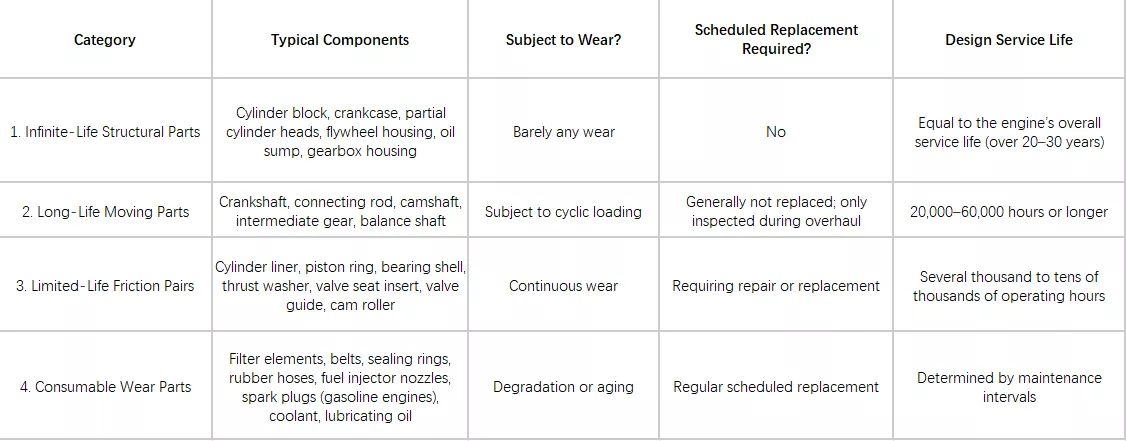
1. Infinite-Life Components
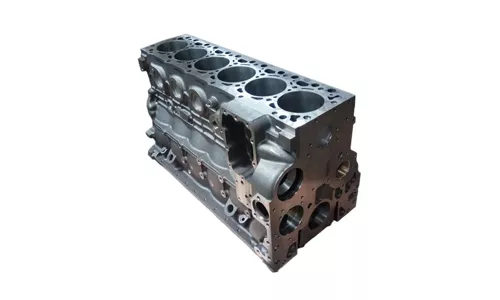
These parts mainly bear static loads or low-stress cyclic loads, and are designed to achieve a fatigue life exceeding the engine’s overall design lifespan.
Typical examples include:
- Cylinder block
- Crankcase
- Flywheel housing
- Gearbox housing
- Support brackets
- Oil sump (under non-corrosive conditions)
Design Principle: Infinite Fatigue Life Design
The operating stress is kept below the material’s fatigue limit, theoretically eliminating the risk of fatigue fracture.
Marine engine manufacturers generally do not specify replacement cycles for such components.
2. Long-Life Moving Parts
Though these components operate dynamically, their service life is guaranteed via fatigue-oriented design.
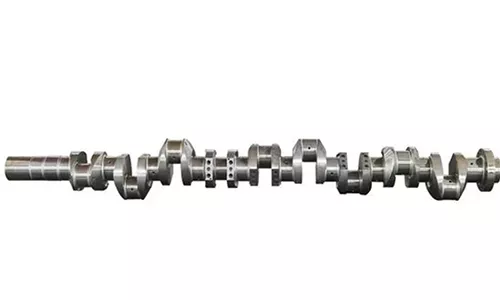
- Crankshaft
- Connecting rod
- Camshaft
- Timing gear
- Balance shaft
Core Features
- Subject to hundreds to thousands of load cycles per minute;
- After 30,000 operating hours of marine engine service, a crankshaft may endure billions of load cycles;
- Mostly manufactured from high-strength forged steel, with surface strengthening treatments such as induction hardening, roller burnishing and nitriding to improve fatigue resistance.
- Magnetic Particle Testing (MT)
- Ultrasonic Testing (UT)
- Dimensional measurement
- Crack inspection
3. Limited-Life Friction Pairs
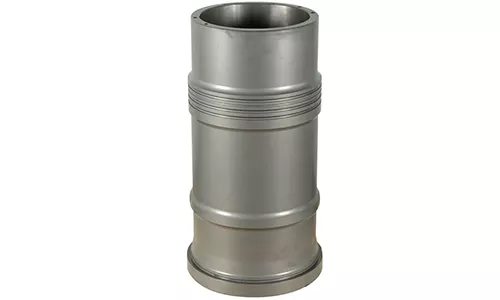
This category is the most critical in engine life management.
Relative motion between mating surfaces inevitably causes wear.
Piston Assembly
- Piston rings
- Piston pins
- Piston skirt
Causes of Wear
- Boundary lubrication
- high operating temperature
- mechanical friction
Once wear limits are reached, the cylinder liner must be replaced or repaired via cylinder boring.
Crankshaft Bearings Including
- Main bearing shells
- Connecting rod bearing shells
Typical liquid-lubricated friction pairs.
Wear is minimal under normal operating conditions, yet the following conditions will accelerate abrasion:
- Poor lubrication
- Fluid contamination
- Overloading
Thrust Bearing
Loads borne:
- Propeller axial thrust
- Axial loads from PTO input and output
- Increased axial clearance of the crankshaft
- Greater crankshaft end float
Valve Train
- Valves
- Valve seats
- Valve guides
- Rocker arm rollers
4. Consumable Wear Parts
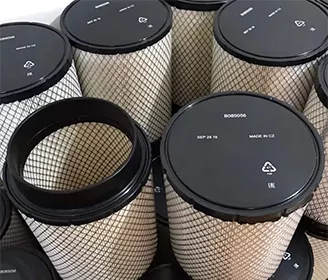
- Aging
- Contamination
- Chemical corrosion
- Engine oil
- Filter cartridges
- Fuel filter
- Air filter
- Coolant
- V-belt
- O-ring
- Rubber hose
- Minor maintenance
- Intermediate maintenance
- Major maintenance
5. Further Classification from the Perspective of Reliability Engineering
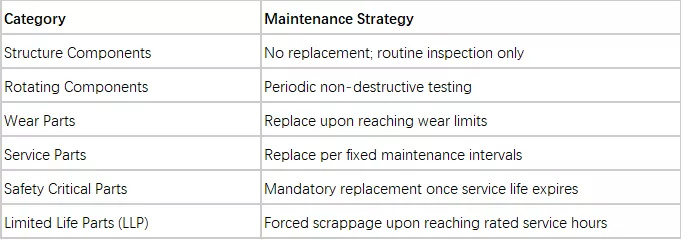
When formulating maintenance strategies, international engine manufacturers classify components for life management into six categories with corresponding maintenance rules as shown below: