As a core mode of transportation in global trade, shipping has long been a major concern for the international community regarding the impact of ship engine emissions on the atmospheric environment. From international conventions to regional and national levels, a comprehensive emission control system with progressively stricter requirements has been established, ensuring both the uniformity of global shipping rules and differentiated constraints based on the environmental needs of different regions.
I. Internationally accepted standard: Annex VI of the IMO Convention on Pollution Prevention
Annex VI of the International Convention for the Prevention of Pollution from Ships (MARPOL), established by the International Maritime Organization (IMO), is the core basis for global ship emissions control. It primarily regulates emissions of nitrogen oxides (NOₓ), sulfur oxides (SOₓ), and particulate matter (PM). NOₓ control is divided into three levels:
Tier I:
Effective January 1, 2000, applicable globally to marine diesel engines with a power output greater than 130kW (excluding emergency equipment). Limits are based on engine rated speed: 17.0 g/kWh for speeds below 130 rpm; calculated using formula 45 × n⁻⁰・² for speeds between 130 and 2000 rpm; and 9.8 g/kWh for speeds above 2000 rpm. During the same period, the global upper limit for fuel sulfur content gradually tightened, decreasing to 3.5% in 2012 and becoming uniformly 0.50% from 2020 onwards.
Tier II:
Implemented from January 1, 2011, it reduces overall emissions by 15% to 20% compared to Tier I. The corresponding limits are adjusted as follows: 14.4 g/kWh when the engine speed is below 130 rpm; calculated as 44 × n⁻⁰・²³ in the range of 130 to 2000 rpm; and 7.7 g/kWh when the engine speed is above 2000 rpm. The sulfur content of fuel in the sulfur emission control area (ECA) must not exceed 0.10%. This stage mainly achieves emission reduction through optimization of the internal engine structure.
Tier III:
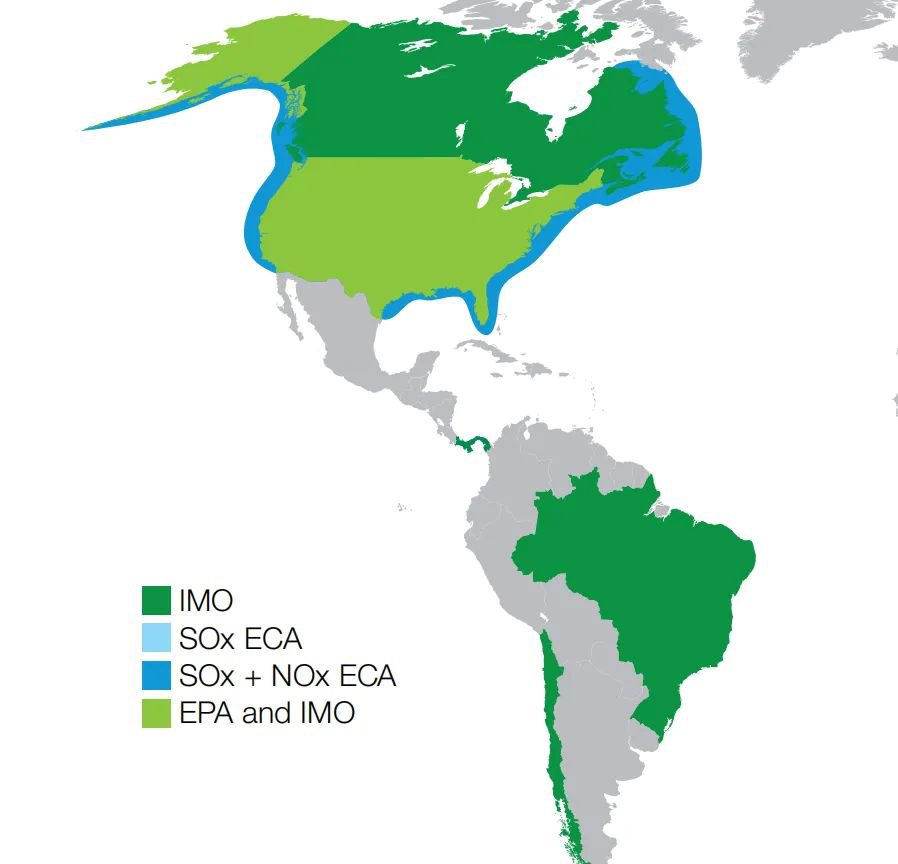
Applicable only within designated Nitrogen Oxide Emission Control Areas (NECAs). It first took effect in North American and U.S. Caribbean waters in 2016 and expanded to the Baltic and North Sea regions in 2021. Emission limits are reduced by approximately 80% compared to Tier II: 3.4 g/kWh for engine speeds below 130 rpm; calculated as 9 × n⁻⁰·² for speeds between 130 and 2000 rpm; and 2.0 g/kWh for speeds above 2000 rpm. Compliance at this stage typically requires after-treatment technologies such as Selective Catalytic Reduction (SCR) or Exhaust Gas Recirculation (EGR), while sulfur content requirements within the ECA remain the same as those for Tier II.
II. Specific Requirements for Regions and Major Countries
Building upon IMO conventions, major economies have introduced more targeted regulatory measures tailored to their own environmental goals:
European Union:
In addition to uniformly enforcing MARPOL requirements for maritime waters, the EU introduced “Stage V” standards (Regulation EU 2016/1628) for inland waterway vessels. Implemented in phases between 2020 and 2022, these standards cover propulsion and auxiliary engines with power outputs exceeding 19 kW. Regulated pollutants include the combined sum of nitrogen oxides (NOx) and hydrocarbons (HC), carbon monoxide (CO), and particulate number (PN); the limits set are among the strictest globally for inland vessels. Furthermore, these standards operate alongside the EU Emissions Trading System (EU ETS) and fuel carbon intensity regulations, creating a dual-constraint framework.
United States:
The marine engine emission standards established by the U.S. Environmental Protection Agency (EPA) are aligned with the MARPOL framework while imposing stricter requirements for inland and commercial vessels. Emission limits are categorized based on engine power and type; notably, engines with a power output exceeding 600 kW are generally required to meet Tier 4 standards, with nitrogen oxide (NOx) emissions ranging from approximately 1.8 to 3.5 g/kWh. These regulations apply to vessels with engines exceeding 37 kW, and fuel sulfur content within regulated zones is capped at 0.10%.
China:
The current standard, *Limits and Measurement Methods for Exhaust Pollutants from Marine Engines (China Stage III)* (GB 15097-2016), implements controls in phases. The Stage I standard, effective July 1, 2018, is 10% to 20% stricter than IMO Tier I. The Stage II standard, implemented on July 1, 2021, further tightens requirements by approximately 20% relative to Stage I, effectively meeting and slightly exceeding Tier II levels; additionally, it mandates a nationwide fuel sulfur limit of no more than 0.50%, with a limit of 0.10% within Emission Control Areas.
Other regions:
The Mediterranean has been designated as a new Sulfur Emission Control Area (SECA), with a requirement for fuel sulfur content not exceeding 0.10% taking effect on May 1, 2025; nitrogen oxide (NOx) emissions remain subject to existing MARPOL regulations. Within Turkish territorial waters, all vessels—in addition to complying with international conventions—must adhere to a uniform fuel sulfur limit of no more than 0.10%, a requirement stricter than the global standard.
III. Core Differences and Technical Directions
Regulatory System |
Standard Tier |
Core NOₓ Limit
|
Fuel Sulphur / PM |
Scope of Application |
Effective Date |
Core Compliance Technology |
| IMO MARPOL Annex VI | Tier I | n<130rpm: 17.0; 130≤n<2000rpm: 45·n⁻⁰·²; n≥2000rpm: 9.8 | Global ≤0.50%; ECA ≤0.10% | Global marine engines >130 kW (emergency‑use excluded) | 2000‑01‑01 | Mainly in‑cylinder optimization |
| Tier II | n<130rpm: 14.4; 130≤n<2000rpm: 44·n⁻⁰·²³; n≥2000rpm: 7.7 | Same as above | Same as above | 2011‑01‑01 | Fuel injection / turbocharging optimization, no mandatory after‑treatment | |
| Tier III | n<130rpm: 3.4; 130≤n<2000rpm: 9·n⁻⁰·²; n≥2000rpm: 2.0 | ECA ≤0.10% | Within designated NECA zones | 2016 / 2021 phased implementation | SCR / EGR mandatory | |
EU |
Stage V (Inland Waterway) | NOₓ+THC by power band: 5.0‑9.8; CO ≤5.0; tightened PM/PN limits | ≤0.10% | Inland waterway vessels ≥19 kW propulsion / auxiliary engines | 2020‑2022 phased roll‑out | Combination of EGR+SCR+DPF |
| Marine Waters | Same as MARPOL Tier II/Tier I (within ECA) | ≤0.10% | Waters under EU jurisdiction | Synchronized with MARPOL | Additional EU ETS / carbon‑intensity control | |
| US EPA | Tier 4 | ≥600 kW: approx. 1.8‑3.5; stricter banded limits for lower power ratings | ECA ≤0.10% | US‑flagged vessels ≥37 kW | 2014 for selected engine models | SCR+DPF+DOC |
| China GB 15097‑2016 | Phase 1 | 10‑20% stricter than Tier I, banded values | Nationwide ≤0.50%; ECA ≤0.10% | Inland / coastal / fishing vessels ≥37 kW | 2018‑07‑01 | In‑cylinder optimization + optional after‑treatment |
| Phase 2 | ~20% further tightening vs Phase 1, close to Tier II upper limits | Same as above | Same as above | 2021‑07‑01 | Optimized combustion + optional EGR/SCR | |
| Other Regions | Mediterranean ECA | Follow MARPOL requirements | ≤0.10% | Mediterranean sea area | 2025‑05‑01 | Low‑sulphur fuel / desulphurization scrubber |
| Turkish Territorial Waters | Follow MARPOL requirements | ≤0.10% | All ships | Current effective | Low‑sulphur fuel / compliant alternative fuels | |
| ——END—— | ||||||


